The
TKD (Ko-on) potentiometers are highly regarded, probably
the best pots in current production. Used by Audio Note,
LAMM and Kondo.
TKD makes excellent feeling and sounding volume controls.
Once you've heard (and felt) the difference between
a € 7.00 volume control and a € 70.00 control
you'll understand why people go to such lengths to get
cheap controls out of their signal path. |

|
TKD
2CP-601 Stereo volume control.
The 2CP-601 is a stereo volume (real log) control, with
a 300 degree rotational angle.
Laser trimmed conductive plastic taper. Maximum attenuation
85dB.
Fully encapsulated.
16 x 26 x 17 mm(depth without bush/shaft), bush height
6mm, shaft length 19mm.
Chassis hole size dia. 8mm, shaft dia. 6mm.
available values in stock: 10K, 50K and 100K
Datasheet-01
(pdf-file) , Datasheet-02
(pdf-file)
Notice : in the datasheet the shaft length is 14mm,
the version we have, has a shaft length of 19mm.
|
| €
28.93
ex.VAT |
€
35.00
incl.VAT |
each |
|

|
TKD
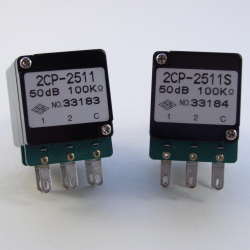
2CP-2511 Stereo volume control.
The 2CP-2511 is a stereo volume (real log) control,
with a 315 degree rotational angle.
Laser trimmed conductive plastic taper. Maximum attenuation
85dB.
Fully encapsulated.
25 x 39 x 29 mm(depth without bush/shaft), bush height
9mm, shaft length 16mm.
Chassis hole size dia. 9mm, shaft dia. 6mm.
available values in stock: 10K, 50K and 100K
Datasheet
(pdf-file)
|
| €
71.90
ex.VAT |
€
87.00
incl.VAT |
each |
|
|
TKD
2CP-2511S Stereo volume control with stepped
action (21 steps)
The 2CP-2511 is a stereo volume (real log) control,
with a 315 degree rotational angle.
Laser trimmed conductive plastic taper. Maximum attenuation
85dB.
This is the same volume control as the 2CP-2511, however
you feel 21 separate steps.
available value in stock: 50K
|
| €
71.90
ex.VAT |
€
87.00
incl.VAT |
each |
|

|
TKD
2P-2511S Stereo volume control with stepped
action (21 steps)
The 2P-2511S is a real (series) stepped attenuator with
a 315 degree rotational angle, made from discrete
resistors and has 21 discrete attenuation steps.
Maximum attenuation 60dB.
With this version you can "feel" the steps.
In comparison to the 2CP version, the 2P offers better
sound quality and even better channel matching accuracy.
available values in stock: 10K, 50K and 100K
Datasheet
(pdf-file)
|
| €
127.23
ex.VAT |
€
153.95
incl.VAT |
each |
|
| Tokyo
Ko-On Denpa
2CP-2511 Stereo volume control.
The
TKD (Ko-on) potentiometers are highly regarded, probably
the best pots in current production. Used by Audio Note,
LAMM and Kondo. TKD makes excellent feeling and sounding
volume controls. Once you've heard (and felt) the difference
between a € 7.00 volume control and a € 70.00
control you'll understand why people go to such lengths
to get cheap controls out of their signal path.
The
channel unbalance for the TKD 2CP2511 is almost as good
as a stepped attenuator. The 2CP2511 achieves this through
it's special design. In parallel to the main resistive
element there are 6 laser trimmed resistors.Each channel
is trimmed for perfect balance and perfect logarithmic
behavior.
|
|
|
|