Graphite fine particles have realized tunnel effect and turned ion transfer of a slow move into Transcendence Electron Transfer of a super high speed move by releasing electrons from ion's restriction |
|
Graphite fine particles have realized tunnel effect and turned ion transfer of a slow move into Transcendence Electron Transfer of a super high speed move by releasing electrons from ion's restriction |
|
|
|
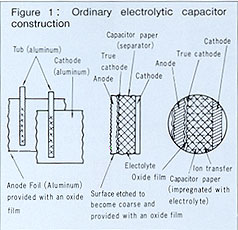 |
However, the electrode in contact with the dielectric consumes the conductive materials so that an even larger contact noise than that found in wet-type capacitors is generated. Furthermore the distortion noise is at levels 40 to 60 dB higher than that from other electric components. This mechanism of dry- capacitors can not be solved, even in the future. This fact was finally understood by the public when Jelmax Black Gate capacitors were disclosed, because Black Gates are so effective at eliminating the distortion. The most widely used wet-type electrolytic capacitor is constructed as shown in figure 1. |
|
A high-purity aluminum foil is etched in order to create a rough surface. Then it is chemically treated to create an oxide film used as the positive electrode. Both the positive electrode, and the negative electrode which is etched in a similar way, are rolled together with a separator in between them. Then electrolyte is impregnated and the whole assembly is sealed in a case. Finally, tabs are connected to the positive and negative electrodes. As a last step, the capacitor undergoes aging with an appropriate direct current voltage to repair foils' defects which may have been caused in the manufacturing process and chemically aging to treat it. Normally, the characteristics of electrolytic capacitors made in this way, such as impedance and tan given in textbooks and catalogs, are all expressed in static characteristics. The dynamic characteristics of capacitors, which are vitally important in examining their behavior in actual use, are not considered. In addition, there is no apparent concern about the kinds of distortion noise described above or about the E.S.R. characteristics which we describe later in this catalog. |
|
Lowering of power transfer efficiency due to electrode foil etchingTo make a compact electrolytic capacitor, its electrode foils are etched to provide a larger surface area for increased electrostatic capacity. It is, however, impossible for the separator between the two electrodes to contain electrolyte proportionately to the increased electrostatic capacity. The smaller the size of a capacitor, the more inadequate the volume of ions to transfer electrons. This means that this type of capacitor is not very effective for power transferring in comparison with its capacity (impedance). Three major problems with an electrolytic capacitorIn short, three major problems exist for electronic equipment using electrolytic capacitors:
These three problems lie in basic structure of the electrolytic capacitor and had long been thought to be impossible to solve. With the recent rapid progress in electronic devices, the inter-electrode distance of as small as 0,5 µm has been regarded inadequate in semiconductor elements. However, no drastic solution has been made for electrolytic capacitors which involve as much as 100 times the electron transmission speed due the use of ion transfer. This is because the electrolytic capacitor consists of aluminum foils, paper and electrolyte, for which no alternatives exist. A lot of improvements have been made for each of these materials. However, no basic have been made improvements regarding the drawbacks of ion transfer. The advantages of electrolytic capacitors, such as compactness, a large capacity, self repairable, ease of manufacture and low cost, make it difficult to obtain alternatives for them. Black Gates are a history making idea which maintain the fundamentals of ion transfer and yet provide electron transfer speedsJelmax has always believed that distortion noise could only be reduced or eliminated by improving the ion transfer system of wet-type electrolytic capacitors. The problem has always been that wet-type capacitors change the signal speed and phase, add ion distortion noise and reduce power which each pass of the signal inside the capacitor. Therefore, we got the idea of improving the separator as a path for the ion electric current, without changing the basic construction of wet-type electrolytic capacitors. Our goal was to bring the speed of ions close to the level of electrons. We succeeded by attaching fine-grained conductive particles to a Manila paper's fibers as separator. Then the electrons could pass along this layer of particles. In other words, our idea was to convert almost all the internal section of the capacitor to electron transfer. This innovation was the idea behind Black Gates unprecedented in the world. A move of electrons on distributed conductive fine particles has broken common senseUntil now, there have always been very strict regulations that
prohibited the inclusion of impurities such as residual ions and
conductive fine particles in separator papers. They had to be kept to
less than 1 PPM because it was believed that "contaminated" separators
were the cause of insulation failure and explosions. The
Black Gate idea meant to introduce more than 100 thousand times the
contaminant limit, by adding graphite particles to the separator. Of
course, all the capacitor "specialists" using their
old-fashioned common sense knew it would be impossible to do what we proposed. |
|
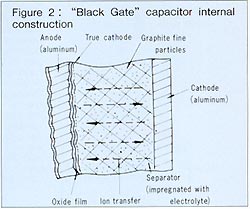 |
shown in Figure 2. The distinctive feature of the Black Gate is the mechanism of it's separator. That is, very fine conductive particles of super-high-purity graphite and other materials are distributed with no contact and applied in the separator made of thin capacitor paper. The separator maintains non-contact against the positive electrode surface too. It functions to improve ion transfer between the actual negative electrode and aluminum negative electrode. Jelmax has made a revolutionary discovery that by distributing a certain amount of graphite particles having a certain particle size in the separator |
|
without contact with each other
and electrodes, tunnel effect has occurred making electrons free from
ion's restriction and run along the fine particles through the separator
to the electrode wherein ion transfer has been turned into ohmic and
super-high-speed Transcendence Electron Transfer. Electrons have been
moving slowly (ion transfer) along a distance 20 thousand times greater
than the dielectric's thickness in the past. With the tunnel effect,
however electrons are turned into instantaneous move making the distance
substantially zero. Noises and distortions generated while the electrons
pass through the electrolyte are disappeared. Moreover, quantity of
moving electrons has no restriction thereby improving power transfer
efficiency greatly. Problems in the conventional electrolytic capacitors
1.,2. and 3. described above are swept up. Overwhelming performance with impedance and E.S.R. characteristics
that are 1/2 to 1/10 those of ordinary capacitors
|
|

|
You may be especially interested to know how much difference
in electrical performance there is between Black Gate capacitors and
ordinary capacitors at the same voltage and capacity. A technical
magazine in Japan conducted and reported an official test of
several 63V/ 2200µF electrolytic capacitors from various manufacturers.
These were purchased at random in Akihabara, Tokyo: the largest marketplace
for retail electronics in Japan. The major findings from this test
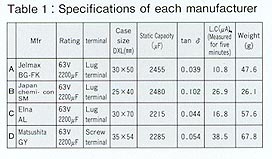
are shown in Figure 3 and 4. As the figures show clearly, Black Gate
capacitors were superior to all other capacitors with 1/2 to 1/10
the impedance and the E.S.R. The report attracted lots of attention
all over the world, and surprised everyone. As shown in table 1. the
Black Gate tested was rather small in size compared with the other
capacitors and it had the best tan of all the capacitors, while exhibiting
the smallest L. C. (leakage current). This means that Black Gates
will have a longer life in any comparable application than any other
electrolytic capacitor. Furthermore, in the E.S.R. (equivalent series
resistance) data in Figure 4, you can clearly see the characteristics
that make our Black Gates' performance stand out from all the rest. |
|
The E:S. R. value reveals the real strength or weakness capacitors. The reciprocal of this value is "Q". When the value of "Q" increases, the resolution of proximate two signals increases. Therefore, the amount of signal information that is accurately transmitted is also increased. This aspect of Black Gate capacitor performance is superior in almost every frequency range. At its best point, this value for Black Gate capacitors is cut to 1/2 to 1/10 the levels of ordinary capacitors and provides an incredible, ideal curve Black Gate have distinctive noise level advantages over dry-type
capacitors
|
|
 |
As described before, dry-type electrolytic capacitors perform an internal electron transfer. However, due to their construction limitations, they are limited to low voltage ranges and have no self-recovery function. Further, they are significantly more expensive than the wet-type. We compared these dry-type electrolytic capacitors, ordinary wet-type electrolytic capacitors, and super-small Black Gate capacitors from our "PK" series (designed to be especially compact). As figure 5 shows, the dry-type capacitors generated large contact noise (because of their construction method) that was more than 60 dB higher than the Black Gates. And the dry-type capacitors didn't even offer better electron transfer. Instead, they will actually decrease the S/N ratio to any appliance they are installed in. |
|
|
 |
Next, we compared ordinary wet-type capacitors and Black Gates, using identical materials and production processes for everything except the separator. The results are shown in Figure 6. The performance differences are obvious. In a CLT-1 distortion comparison, Black Gate capacitors had 40 to 50 dB less harmonic distortion than ordinary wet-type capacitors. This means that the ion transfer distortion normally found in the separator has been eliminated in Black Gate capacitors. |
|
|
 |
As show in Fig. 7, the Black Gate does not show any deterioration in performance at temperatures as low as -40°C as compared with conventional electrolytic capacitors. This benefits electronic equipment for use in low-temperature environments. It is known that conventional electrolytic capacitors show substantial deterioration in performance due to the freezing of an electrolyte. |
|
|
|
As explained above, the Black Gate uses conductive graphite particles as a bypass for electrons. This makes the product suitable for instantaneous charging and discharging of large electronic energy as with strobe flash equipment. Generally, the luminous curve at the tine of discharging depends on the capacitor's E.S.R. value. The smaller the E.S.R. value, the higher the peak il luminance level. The Black Gate is therefore very promising for use as a Plasma discharging capacitor as well. The use of a Black Gate capacitor in an inverter for a fluorescent lamp can deliver a substantially improved level of performance thanks to its very high power transfer efficiency. It is possible to make a compact, lightweight, low-cost power supply unit using a Black Gate capacitor. |
|
|
|
|
Among the many accomplishments
of the various Black Gate capacitor series, non-polarized Black Gates
deserve special mention. Ordinary non-polarized electrolytic capacitors
are made by facing oxide-coated positive electrodes toward each other so
that the internal electrical potential changes to match every
alternation of current direction. They cause greater deterioration of
both phase and distortion characteristics than ordinary capacitors do.
They are produced in small quantities and sometimes appliances
containing these capacitors are rejected. But, Black Gate BG-NX
non-polarized capacitors, conductive separator particles function as
gate electrodes in stabilizing the zero potential of alternating
current. Non-polarized Black Gate capacitors offer enhanced performance.
They beat out every other kind of capacitor. The fine graphite particles
play an important role here, as well. |
|
|
|
|
Our unlimited pursuit of the technology used in Black Gates finally led us to develop L-canceling pairs of non-polarized Black Gates. We connected two identical non-polarized Black Gates (BG-Ns or BG-NX's). Together they cancel the resonance generated by their internal inductance. This method results in ideal capacitors whose impedance an E.S.R. values decrease as the frequency increases. We named these capacitors "Super E-Caps". This system completely eliminated the internal resonance of the capacitors. As a result, we were the first to be able to completely eliminate ripple and EMI noise in DC/DC converters and switching power supplies. This problem had Plagued electronic appliance designers, but we solved it. Details of this system are described in the catalog for Super E-Caps and in our Technical Reports, No. 71 and 85. We suggest you read these reports for more information. (Recently granted patent No. 2,606,771,U.S.P.5,379,181). |
|
|
|
|
In polarized electrolytic
capacitors, there exist no capacitor action from cathode to anode
electrodes. This is the reverse current. More precisely, not only a
positive direction current but also a negative direction current forming
a part of an alternate current flow in the capacitor which cause
distortions and noises. In a larger scale, the flows generate a gas by
heating the electrolyte which is a cause of short life. |
|
|
|
 |
Recently, it has become a real problem that
electromagnetic waves emitted from inside of electronic devices give a
harm to a human body or high grade medical appliances. Harmonic noise
having a wide frequency range generated by a power supplies or circuits of cell phones, digital cameras or personal computers are real problems
which give anxiety to users of such devices. There is a move to restrict
the problem by contacting a treaty on a world wide base. |
|
These curves clearly show that the
source of the electromagnetic waves is the electrolytic capacitors. |
|
|
|
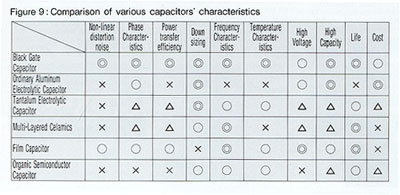 |
Fig. 9 is a comparison table in which characteristics of capacitors ordinarily used for electronic devices and the Black Gate with respect to 10 items. According to the table, the Black Gate gets full scores for all the items. Since such difference has never been achieved before, this fact shows that the status of King of Capacitors will be firm in the coming century. |
|
|
|
In Black Gate capacitors, we applied almost all of the path as electron transfer channels. As described in the earlier paragraph concerning impedance, Black Gate capacitors offer better characteristics than ordinary capacitors with five times the capacitance. In addition, they crate only 1/1000 (-60 dB) the internal distortion, offer 100 times faster internal signal transfer rates, and have 2 to 3 times the power transfer efficiency of ordinary capacitors. These performance levels are previously unprecedented. They are beyond the comprehension of people who cling to old, wrong ideas about electrolytic capacitors. But, these performance levels have been independently verified. They are FACTS! When you use Black Gate capacitors throughout your appliance design, you will get surprising results. Our Technical Reports are useful guides for your application of Black Gate capacitors in designing appliances. Jelmax´s decade-long accumulation of valuable knowledge has been published in first class technical magazines and in over a hundred Technical Reports. These reports have been very well received and are considered trustworthy in the information they present. The contents of many of these reports have been used as topics for in-house education programs and as texts used by technicians and educators, because they contain valuable information not available in books or schools. Some of these reports have been translated into English and have been well received around the world. Copies of these reports are available upon request. Black Gates have already been adopted for use in appliances manufactured by dozens of firstname electric appliance manufacturers both in and outside of Japan. They have contributed to tremendous increases in the performance of these appliances. Black Gate capacitors are welcomed as one of the biggest electronic parts innovations in the 20th century. The applications are limitless in all sorts of electronic devices and equipment, such as radios, TV sets, cameras, VTR's, tape recorders, stereos, audio appliances, CD players, digital processors, communications equipment, medical instruments such as MRI/CT/DSA/US, electron microscopes, AD/DA converters, AC/DC power supplies, DC/DC power supplies, works stations, fax machines, high resolution copying machines, printing machines, laser instruments, NC tools, etc. Black Gate capacitors are now recognized all over the world as indispensable components in decreasing the noise found in high resolution portable equipment for multi-media use. The spreading use of Black Gate capacitors is guaranteed since it would be impossible to develop capacitors superior to Black Gates. The primary technology used in Black Gates is described in Reports No's. 50, 51, and 52. We strongly recommend that you read these reports. |
|
|
|
|
As explained above in detail, distortion noises due
to ions which are to exist essentially disappeared from the inside of
the Black Gate because the Transcendence Electro Transfer took place
based on the surprising tunnel effect inside the electrolytic capacitor
of ion transfer. This is a big news which has never heard before. As a
result that the largest noise source in electronic circuits has
disappeared, the target S/N (Signal to Noise Ratio) of all the
appliances has been improved at a degree which has never been
experienced before with a rapid decrease in circuit noise level. We
replaced all the capacitors with non-polarized Black Gates of the
set in CLT-1, a distortion measuring device having the highest
sensitivity. Then measured the distortion of itself. Remarkably, the
result showed that improvement with more than 20 dB was realized.
Consequently the limitation of the measuring value reaches - 180 dB.
This is an evidence that S/N of all the electronic devices are also
improved by more than 20 dB. |
|
|
|
|
If a Black Gate capacitor mounted on an electronic device is actuated, a signal current flows into it and the electrodes are gradually activated, reducing non-linear distortion and phase distortion substantially while improving the efficiency of power transfer efficiency. The time required for this process varies widely with the capacity, voltage and signal level. A total of about 30 hours is the standard level. Once this process of idling is completed, the effect continues as long as the capacitor is kept at the same place and the operating environment does not undergo a substantial change. The effect of idling has been proved with all types of electronic equipment-analog, digital, high-frequency and other devices. It must be noted that idling is different from aging, which applies a direct current voltage without giving signals. |
|
|
|
| Japanese Patent: No. 1,368,245;
1,662,570 New Patent No. 2,606,771 U.S. Patent: 4,345,302; 5,057,972; 5,379,181 German Patent: 2,900,742 Trade Mark: No. 1,601,800; 1,601,801 No. 2,503,956; 3,132,300 |
|