|
DHT
Filament supply
Despite
their massive linearity, Directly Heated Tubes (DHTs)
have one major disadvantage. Their heater is part of
the signal flow, it is included in the audio path, hence
the heater supply is affecting the sound.
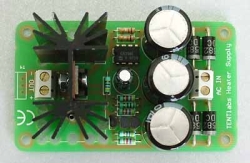
TentLabs now introduces a heater module, based on traditional
techniques, but with some major advantages over existing
solutions.
Reviews
Read what Dick
van Merwe (pdf-file) writes about these filament
supplies.
" What I hear, compared with my earlier applied
DC heating, is increased articulation, an improved focus
and clearance between instruments and soloists. The
soundstage increased in depth. The original supply has
a softer tone, you could call it dull – do I want
that back? No way, not at all. And I was surprised by
the result, especially compared with the small amount
of work to be done... "
Clive
Meakins tests the DIYhifisupply
ladyday kit, including Tentlabs filament supply,
and concludes:
" Part of this smoothness is attributable to the
Tent Labs heater supply, comparing the standard supply
to the Tent Labs one shows a higher degree of smoothness
"
" Hum levels are vanishingly low, with my 100db
loudspeakers I can just hear a trace hum up to around
8cm from the main driver "
Read
what Rob Hubertse (DHTrob) experienced with these modules
" I installed the Tentlabs filament supply on my
DIY lady day 300B mono's and I must tell you it is a
very worth while and cost effective modification. The
tonal quality of my amps has improved as well as lowering
the noise floor to almost undetectable amounts "
Other
customers feedback
" Just wanted to drop a note to say I installed
my supplies this weekend. I originally switched to DC
supplies last year because of hum. However, I have not
been happy with the sound since. That is until installing
the Tent supplies. Installation was a breeze and the
sound, from the moment I switched the units on was much
better. Gone was the for the lack of a better word,
"dullness". Back came the detail and crispness
that I had before going DC "
" A few weeks ago I asked about using the Tentlabs
filament power supply for my field coil speakers. Well,
I tried them and I have to say that they are best power
supply I've used with these speakers "
Purpose
The TentLabs filament supply is designed to heat DHT's
the cleanest way possible, without affecting the music
currents generated inside the tubes heater. The supplies
generate a very low noise output, while maintaining
its' high output impedance. Result areas are:
• Bigger soundstage
• Better focus
• Cleaner tone
• Better resolution
Existing
current supplies lack true high output impedance and
need adjustment during use. This new module is truly
different in many areas - read on !
Technology
An overview of the TentLabs supply is shown below:
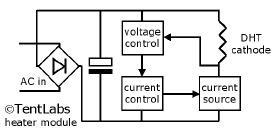
The
current source maintains the high output impedance (typically
> 10kOhm), whereas the voltage control takes away
the need to trim the output voltage after installation
or during use. The accurate reference guarantees long
term stability, and contributes to a clean output current.
The module exactly supplies that amount of heater current,
until the required DC voltage is achieved, e.g. 5V for
a 300B.
The
rectifying bridge consists of low noise Schottky Barrier
diodes and electrolytic capacitors (a total of about
20.000uF for the 2.5A version and 34.000uF for the 5A)
with a well chosen amount of ESR, to dampen and reduce
the current peaks. This all contributes to low noise
output !
In
addition, the chosen diode bridge, smoothing capacitors
and power control contribute to an efficient module:
Only 5.8Vac is needed to supply a filament module feeding
a 300B.
Application
A typical example is shown below:
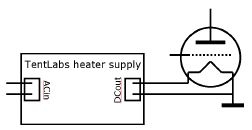
Each
tube needs its own filament supply turn fed by a
separate winding from the power transformer.
The whole supply then is floating, and only has one
connection to ground, as shown above. (This example
above shows the DHT in fixed bias mode. When using cathode
bias, the grounded leg has to be connected to the top
of the cathode resistor instead)
These
are the only connections to the filament, so no caps,
no hum-bucking pot !!
The
total output current is limited, depending on the version,
but they all start-up slowly. Especially when the tube
is cold, this is a nice feature. Cold tubes, when heated
with traditional supplies, draw currents up to ten times
their nominal current. Using TentLabs heater supply
will gently switch on your tubes.
The
units are factory adjusted at your order. After installation,
the supply needs minor DC adjustment, to compensate
for possible voltage losses in the wiring (some 100
mV are easily lost at high currents). During use, no
adjustments are needed anymore, not even after changing
the tubes !
The
new generation filament supplies has an over temperature
indicator and shutdown, in case the heatsink-temperature
exceeds 90 °C. The LED and wiring is supplied separately
with the modules.
Application & mounting
Look at the Application info for detailed mounting instructions
and study the voltage chart to see which AC tension
is required on your power transformer.
Application
Info
Voltage
chart
Specifications
• All versions voltage adjustable between 1.5V
and 9V,
specify when ordering.
• Higher output voltages available on special
order
• Output current: automatically adapts to required
level to reach voltage specified above.
• Input voltage should not exceed 1 V above specification
(see application info).
• Output noise < 20 uVrms (1 Hz - 20 kHz).
• Output hum < 200 uVpeak at 100Hz / 120Hz.
• Output impedance 10 mOhm at 0Hz.
• Output impedance 10kOhm > 5Hz.
• The heatsink is electrically isolated from the
circuit and can be attached to a chassis
• Over-temperature shutdown with LED indication
Notes
1. The unit will not work without output
load, a minimum of 200mA is required
2. The output is not short circuit
proof
Available versions
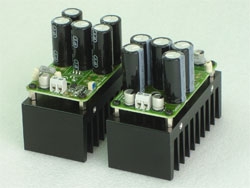
• Low noise version, output currents
up to 1A.
These typically serve small size triodes to be used
as line stages. Output noise is 26dB lower compared
to the standard version. Often used in conjunction with
type 26 tube, integrated heatsink.
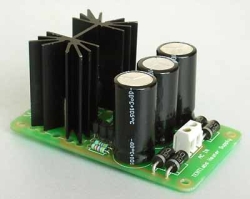
• Standard version, output currents
up to 2.5A.
These typically serve small and medium size triodes
up to output tubes like 300b and 2A3, and have an integrated
heatsink.
• Output currents up to 5A.
These will suit the beefy types like 211, 813, 845 and
SV572 and have a bigger heatsink.
Mechanical specifications
1A and 2.5A unit:
• Total size 50*90*40mm (W*L*H, heatsink included,
standoffs excluded).
• Weight each 90 gram (each, excluding packaging)
• Hole pitch 41* 81mm.
• Needs 10mm stand-offs to mount on chassis, supplied
with modules.
5A
unit:
• Total size 50*100*90mm (W*L*H, heatsink included).
• Weight 375 gram (each, excluding packaging).
• Needs M4 bolts to mount on chassis, not supplied
with modules.
Warrantee
5 years of warrantee is valid for the filament supplies,
assumed they are build in according application information.
Safety
Though this is a product which if handled properly is
save, it is surrounded by high voltages. Working with
high voltages requires safety measures and professional
behavior. Tentlabs takes NO responsibility for accidents
resulting from improper usage or handling.
|