BYBEE
INSIDE
I
have a history of being a tweak. If someone makes some
gadget for an audio system, doggone it, I try it. Some
have made subtle differences, but not really improvements.
Others made a difference for the worse, while others
have made a difference that, while subtle for some,
were enough of an improvement for me to make them permanent
additions to our system. Unfortunately, none fall into
a single category. For example, cones and feet fall
into all three categories:
1)
Some make a difference, but I could live with the sound
either way, so who cares?
2)
Some make an improvement.
3)
Some make things sound worse.
The
truth is—different system, different listener,
different results. Then, along came the latest and greatest
from Jack Bybee. I have been interested in the Bybee
devices for some time and even acquired a sample pair
to review a year or so ago. However, since it was necessary
to solder them into the speakers at the positive terminals,
and since my preamp inverts phase, what would I do if
I got another preamp for review? Too many choices, too
many decisions! I guess I was not sufficiently motivated
to take the plunge, so off they went to Francisco, who
fell in love with them and has now installed several
pairs in his speakers.
What
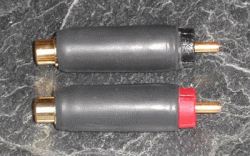
we have here is a different animal. These are the new
Bybee Slipstream Magic Bullets or Slipstream Quantum
Purifiers, not the older Quantum Purifiers. These carbon-fiber-based
purifiers represent Jack’s continuing development
of his technology to address noise at the quantum level.
Noise at the quantum level, you ask? Well to make it
as simple as possible for you, and even more so for
me, let me quote from the Bybee website:
Within
any playback system, musical and visual information
is transmitted through components and cables by electrons
flowing through conductors. As individual electrons
interact with the conductive materials of cables and
circuits, very low-level (quantum) noises are generated.
As quantum noise energy accumulates in the propagating
signal, low-level details pertaining to ambience, soundstage,
timbre, dynamics, color fidelity and picture resolution
are obscured, robbing the presentation of vividness
and life…. During transit through the Quantum
Purifier, quantum noise energy is stripped off the electrons,
streamlining their flow through ensuing conductors.
Unwanted quantum noise energy dissipates as heat within
the Quantum Purifier rather than emerging as a layer
of contamination residue over the audio/video information….
As electrons speed through the purifier, a "slipstream"
effect is formed which facilitates current flow in the
surrounding conductors of the playback system. Introducing
Bybee Quantum Purification into the electron path enhances
noise reduction and signal velocity, resulting in performance
improvement beyond what is attainable by any cable alone,
no matter how well designed.
If
that is not simple enough, or perhaps too simple, Dick
Olsher of enjoythemusic.com explained it a
bit differently in a review of the older Purifiers that
appeared over a year ago. I assume that Dick’s
explanation applies to the Slipstream version, and that
the new version is simply better at addressing quantum
noise. Dick wrote:
…
signal conduction in all electronic circuits is based
on the movement of electrons through the crystal lattice
of conductor materials. While the signal does indeed
propagate at the speed of light, individual electron
motion is extremely slow and ponderous. Ultimately,
the noise floor of any electronic circuit is due to
the quantum nature of the electron and its interaction
with the crystal lattice through which it moves….
Random thermal motion of the charge carriers produces
a small fluctuating noise potential, whose power is
uniform over frequency—so called white noise.
Thermal noise places an ultimate limit upon signal to
noise performance in real circuits, which cannot be
improved upon without cooling the circuit. Shot noise
occurs in certain devices (e.g., vacuum tubes) due to
random fluctuations in current and its spectrum is also
white in character. In contrast, thermal noise is usually
not an issue with solid-state devices. However, for
many solid-state circuit elements (e.g., MOSFET), the
noise floor is dominated by frequency dependent noise,
often referred to as 1/f noise…. The key point
is that 1/f noise behaves like the musical spectrum.
Its envelope mimics that of the musical signal. Recent
research indicates that perceptually such noise blends
in very well with the music. Once buried within the
music, it is reasonable to speculate that 1/f noise
defuses image outlines and adulterates harmonic textures.
After all, the sonic benefits of the Purifier are exactly
in these areas…. The basic premise of the Bybee's
audio devices is that 1/f noise detracts from the listening
experience: reduce 1/f noise and you improve the sound.
Let
me see if I’ve got this straight. Noise is unavoidably
generated at the quantum level by the flow of electrons,
in either a component or wire. This noise is not heard
as noise, but as an obscuring of the music signal, much
like the corona of the sun distorts the visual edge
of the sun’s circumference, or how a soft-focus
lens hides the finer details of a photographic image—you
can easily see the image, but it is blurred. If we could
remove this quantum noise, the musical signal would
be cleaner and more defined, with less distortion. We
would hear more of the music, as it snaps into greater
focus. We would not be retrieving details lost in the
mix, but the overall clarity of the recorded event,
and we would not only hear more detail, but gains in
soundstage, ambience, air, palpability, etc.
Perhaps
also, quantum noise requires greater unconscious effort
on the part of the listener, who must listen past it
to get to the music. If so, putting the Slipstream Quantum
Purifiers in a system should cause the listener(s) to
exert less effort, thereby creating less stress. Other
tweaks have similar results, but these are usually related
to a smoothing of the musical signal by a softening
of the top end. There is plenty of noise that rides
above the music’s highest frequencies, and removing
this noise is paramount in getting to the music on an
LP or CD, but too many products address this by cutting
too deeply into the higher end of the frequency spectrum.
The ideal is an extended top end with no added noise
from the AC and other crap that pollutes the sonic environment.
I use many approaches—AC filtration, dedicated
circuits, Walker Audio High Definition Links, and more—to
fight this evil scum, all with excellent results.
So
if we are right, then both explanations indicate that
the Bybee Quantum Purifiers address noise in a way that
is not frequency dependent. Therefore, while the Slipstream
Quantum Purifiers presumably make it easier to listen
to the music by eliminating noise, it is not at the
expense of a rolled off top end. There should still
be plenty of top end detail—possibly even more—meaning
that the Bybees will not make a bright system or recording
less bright. It might even make them brighter!
So
far I have only tried two Slipstream Purifiers, one
per channel at the inputs of the amplifiers (that is,
at the ends of the interconnects coming from the preamp).
While I could just as easily have used them elsewhere
in the system, I reasoned that if they "filter"
the quantum noise created within the audio chain, it
is best to do so as close to the end of the chain as
possible—at the amps, before the noise is amplified
or passed onto the speakers. Though the amplifiers,
speaker cables, and speakers generate their own quantum
noise, the speaker versions did not like my terminations
and did not stay put. Several manufacturers are now
using the Slipstream Quantum Purifiers inside their
speakers for this reason, and then there are all the
guys who use them inside CD players at the outputs and/or
the AC inputs. I know people who use the Slipstream
Quantum Purifiers at just about every connection, so
I am going to try two more at the outputs of the preamplifier.
Since I am running three-meter interconnects, it may
be a good idea to have the benefit of another set, although
this may be too much of a good thing. I will report
on this in a follow-up.
For
now, all I can say is that the Purifiers do what they
are supposed to do, and do it very well. With the two
Purifiers in my system, the music flows with a greater
sense of ease—it is simply more musical, and more
whole. There is less stress (to the music and to me),
with no loss of detail or treble extension. I hear more
of everything that I want to hear, as the music comes
across with an increase in clarity and presence. There
is more air, more space, more thereness—it sounds
so much more like real music. It is as if the Purifiers
have removed an ever-so-subtle soft focus. Images stand
out with greater dimensionality and there is more space.
I hear further into the mix with a lot less effort,
and the ebb and flow—not only of the music but
of the instruments themselves—comes across with
more power and ease. Texture is turned up several notches,
as is that ever-elusive quality of musicality. With
the Slipstream Quantum Purifiers in the system, music
rocks!
Get
rid of quantum noise and you will be amazed at how good
things can sound. You never knew it was there until
it is gone. It’s sort of like wearing glasses
without knowing that you need an adjustment in your
prescription. Get that new prescription and wow, things
look so much crisper and cleaner. I thought my system
sounded great before, but now it sounds even better.
Are there any downsides? None, except the cost of admission,
and while the Bybees are not exactly cheap, their cost
is quite reasonable given their effect. Oh and they
did not make things brighter—just better! Highly
recommended.
Dave Clark
|
|