|
Bybee technologies
Do you ever think about the pile of money you've spent
on tweaks that gave little—if any—musical
improvement in proportion to the amounts you spent?
Let's not forget the inconvenience of balancing your
preamplifier, CD player, or amp(s) on bearings, plastering
your speaker drivers with adhesive dots, and blue-tacking
spikes to everything else in your system. I'm guilty,
too, and the proof is in that pile of stuff that I have
in the corner of my back room.
In
our quests to improve the sound of our systems, we gearheads
will try just about anything, but, as many of us have
found, the improvements accessories bring are often
incremental at best. Many times, the differences are
barely perceptible. In addition to the cost and questionable
sonic improvements, there is the "huh factor"
that emerges when you try to explain to your non-audiophile
family and friends the enormous sonic benefits reaped
because your wires are lifted just the right height
above the floor, and are routed around other cables
in the correct manner. I too have seen that embarrassed
look on my friends' faces. Also, my wife absolutely
refuses to use the CD player with "those dumb bearings"
under it, for fear of knocking it off the shelf. Perhaps,
in the back of our minds, we are starting to admit that
many of these devices don't work all that well, but
the quest for better sound is still there, and the urge
to improve our systems is greater than the gravity that
holds our wallets in our back pockets. This is part
and parcel of what being an audiophile is about.
If
we are going to spend precious time and money in an
effort to improve our sound, why not spend wisely? How
about buying high quality capacitors and resistors and
soldering them in place of your old ones? That certainly
changes the sound of a component, but it is also a crapshoot,
and you are playing the game of second-guessing the
intentions of the designer. Although I have had positive
experiences with capacitor modifications in my gear,
not all audio equipment benefits from replacing ordinary
caps with more expensive or exotic ones.
This
brings me to a rather sticky point—electronic
surgery. How many of us are ready, willing and able
to take a hot soldering iron and wire snips to our sacred
high end gear? I know some guys that are afraid to snap
a ferrite ring around the captive power cord to their
CD players in the fear that it will dent the cord! If
you are remotely that kind of audio buff, you can forget
the Bybee Technologies Quantum Purifiers, but you will
be bypassing one of the best new finds for improving
the music-making ability of your system.
I
have already discussed the benefits of Bybee technology
in my Balanced Power Technologies 2.5 Ultra review.
Recently, we at audioMUSINGS/Positive Feedback Online
were lucky to meet Mike Garner of CryoTweaks. Among
the products and services that Mike sells are the devices
from Bybee Technologies and from the mind of Jack Bybee.
The Quantum Purifiers are said to work at the subatomic
level to reduce electronic noise. They are made from
ceramics that are doped with oxides of rare-earth metals
such as zirconium and neodymium. The devices are electrically
passive, and are said to be stable in any circuit. What,
a device that doesn't interfere with the musical signal,
but cleans it up? This sounds too good to be true.
The
Bybees come in two versions. There is a "plug &
play" version, which is a little component with
connectors on each end and Bybee Purifiers in between.
It can be installed between your speaker wire and speaker
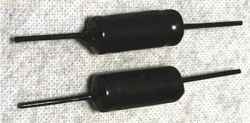
connectors with no soldering required. The other version
looks like a big black resistor, and comes in two sizes.
The larger ones, which are 2 inches long and 9/16 of
an inch in diameter, are used in AC applications, and
with all loudspeaker drivers where space is not an issue.
The smaller devices measure 1 inch long by 3/8 of an
inch in diameter. These can be used in lower-current
AC circuits, or in situations in which the larger ones
won't fit. Both have one-inch copper leads at each end.
Mike
Garner sent two of the large and two of the small purifiers.
After I exchanged a few e-mails with Mike, we decided
that the small ones would go into my Nohr CD-1 CD player.
I installed them between each positive wire from the
circuit board to both the left and right output jacks.
For the speakers, the most beneficial application was
between the positive wires from the crossover to the
positive terminal on each woofer driver. I know that
this involves some electrical surgery, but it was outpatient
surgery—in each case, the units were in and out
in about 15 minutes. Credit is due to Ed Morawski for
the solder work.
As
far as break-in time goes, 72 hours did the trick. Ed,
who had my CD player for several days before and after
the installation, said that he easily noticed an improvement
after the modification. As for the speakers, I took
them home immediately after their Bybees were installed
because I wanted to give them a full break-in before
any serious listening.
I
started out by removing the Balanced Power units that
reside in my system, as they both have Bybee Purifiers
inside them, and I didn't want them to influence what
I was hearing. They were replaced with two Brickwall
units. The Nohr CD-1 CD player and Spendor 2/3s were
installed and listened to separately. Although improvements
were noted in both, it was in the speakers that they
were most notable. After a lot of listening, I reinstalled
my BPT units, and this simple experiment showed the
cumulative effect that the Bybees had on the system.
The
strong suit of the Bybee Purifiers is coherence. Music
now flowed more uniformly out of my speakers. The Bybees
brought solidity and focus to the music, as if its basic
elements were suddenly commanded to stand at attention
and march in unison. Another analogy might be listening
to a high school band playing Wagner's "Ride of
the Valkyrie" at a football game, and the next
night listening to the L.A. Philharmonic play the same
piece. I had the distinct feeling that I was hearing
better integration of the drivers in the Spendors. It
was as if the music was coming out of one big driver
that covered the frequency spectrum, as opposed to two
in a box on each side of the room. At the same time,
the performers were on a very three-dimensional space.
The soundstage improved from front to back and sideways.
The atmospheric qualities of both my CD player and speakers
were now bumped up a few notches.
A
noticeable reduction in glare and—to a slight
extent—grain was apparent with the Bybee mod.
I thought that my components had as little grain and
glare as possible, but I noticed improvement in these
areas just the same. With them came an increased clarity
and inner detailing. Background sounds and lyrics that
were barely perceptible were now easy to follow, yet
details were not hyped up or exaggerated due to added
brightness. Rather, they were more fleshed out, and
more a natural part of the soundscape. Suddenly it was
easier to follow the words to the songs on several of
my UB40 and Black Uhuru CDs. On a couple of Tom Petty
CDs, it was easier to hear how his southern drawl is
part of what makes his singing unique. And on Sergio
Mendes' disc Brazil, the subtle instrumental brushes
on percussion bloomed in a more effortless manner.
The
bass on every CD that I played sounded more full and
deep. At first I thought that there was a bump in the
bass/midbass, and was a bit concerned, but my fears
diminished with time. With a little more break-in, the
bass range tamed down, and an even tonal balance was
restored. The additional break-in brought solid, textured,
and flexible bass performance. There was freshness and
liveliness to all of the discs that I played that my
speakers and CD player lacked before.
I
really liked the effect of the Bybee Quantum Purifiers.
They brought an evenness and cohesion to the music that
for me was well worth the price of admission. The Bybees
smoothed out all of the wrinkles in timing, dynamics,
and space, and brought all of the musicians together
as a musical whole. The Bybee Quantum Purifiers are
more than frivolous tweaks. They are a legitimate upgrade
in musical satisfaction. Highly recommended!
Francisco Duran
|
|