Snake
oil or breakthrough?
That's the question that ran through my mind when I
first heard of Bybee Quantum Purifiers.
Jack Bybee is a physicist whose work in Quantum Physics
led to the development of the Quantum Purifiers for
certain military applications, some of which are still
classified. Until five years ago, Jack offered versions
of these filters to audio and video enthusiasts keen
to improve the level of signal purity in their home
systems. Since that time, the products have been off
the market but Jack is now back with an improved range
of products using refinements of the original technology
containing improved materials. These are the new carbon
fiber-based Slipstream Quantum Purifiers. He also has
a silver and carbon fiber version designed for digital
circuitry. They both measure one third of an inch in
diameter and one inch in length. The compact dimensions
of these filters have allowed Jack to develop a new
broader range of products incorporating the Purifiers,
and it also makes it easier to introduce the Purifiers
at key points in the circuitry of electronic components
and speakers. For example, in his Level-2 modifications
to the Denon DVD-5900 universal machine, Chris Johnson
of the Parts Connexion includes a pair of 'pure silver'
Slipstream Quantum Purifiers at the main audio outputs
(just prior to the RCA jacks) and a regular pair at
the AC input (primary side of the power transformer).
If
you want to incorporate Quantum Purifiers into your
system, you have a wide choice of methods. You can buy
hardware from a list of manufacturers who have chosen
to include them in their electronics and speakers. If
you have the skills, you can insert Jack's devices inside
your components (at the inputs and the outputs) or build
them into your speakers or even cables. Or you can have
professionals do it for you if this is beyond your abilities.
You can buy power cables, interconnects or speaker cables
with Quantum Purifiers already built in or use one of
the Magic Bullet products, which extend your existing
interconnect cables by a short length like a pigtail.
And that's the subject of today's test - a short addition
to a balanced interconnect. You can also acquire Power
Chargers or Speaker Chargers that perform similar functions
as extensions to your power or speaker cables.
Okay, so what's a Quantum Purifier? For an extracted
quote, here goes:"Bybee Quantum Purifiers operate
on the quantum mechanical level to regulate the flow
of electrons that make up the signal (picture a metering
light regulating freeway traffic flow). Current flow
within the Quantum Purifier is unimpeded and ideal (think
of the unencumbered flow of traffic on a lightly traveled
expressway). During transit through the Quantum Purifier,
quantum noise energy is stripped off the electrons,
streamlining their flow through ensuing conductors.
Unwanted quantum noise energy dissipates as heat within
the Quantum Purifier rather than emerging as a layer
of contamination residue over the audio/video information."
About the Slipstream XLR Magic Bullet, Jack writes the
following: "Within each XLR Magic Bullet, carbon
fiber Slipstream Quantum Purifiers operate on the signal,
return and ground paths. Premium Neutrik XLR connectors
attach the Magic Bullets to the downstream ends of your
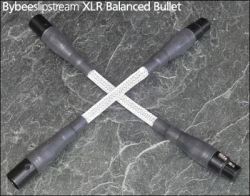
interconnect cables." The device is about 11"
in length, with a flexible white mesh-covered cable
of about four inches terminated with a rigid black Neutrik
XLR female on one end and the male equivalent on the
other. The Quantum Purifiers are mounted just behind
the Neutrik plugs inside the hard casing. The finish
is of a high quality. I connected these cables at the
amplifier end of my balanced Soundstrings interconnects
between the Meridian CD player and Perreaux Radiance
R200i. On Jack's recommendation, I passed signal through
the devices for 100 hours before commencing my evaluation
in earnest.
I played a variety of music but any one piece would
have been enough - the results were remarkably consistent
throughout: The music gained in coherence and clarity.
In every case, I preferred listening with the Slipstream
Clarifiers in the circuit.
During
Peter Schreier's beautiful recording of Mozart's Requiem
[Philips 411 420-2], the sound with the Bybees in the
circuit actually deteriorated badly because I started
singing along with the "Kyrie". Clamping my
jaws shut, I listened again. The small degree of sibilance
which is present in my regular setup was reduced although
not eliminated. Transparency increased slightly and
the bass notes from the orchestra came through more
clearly. These changes, though small, combined to increase
the sense of involvement enough to get me singing. And
that's a good thing.
Dinu Lipatti's transcendental performance of Bach's
"Partita in B Flat" from Great Pianists of
the 20th Century [Philips 456 893-2] comes as close
to perfection as any I know of. But the sound, recorded
in July of 1950 just before his untimely death, does
not do justice to his artistry. Although the version
offered on this disc improves sonically on earlier releases,
I would pay good money for any device that could improve
it further. Unfortunately, the Bybee Purifier improved
the shallow sound just a fraction with slightly stronger
bass and a small edge in the musicality of the piano
tone.
I
wondered how the Purifiers would cope with a much more
complex and massive mix of instruments, so I tried Klemperer's
rugged performance of Bruckner's 6th Symphony with the
New Philharmonia Orchestra [EMI Classics 7243 5 67037
2 8]. This recording dates from 1964 and features the
fine acoustics of London's Kingsway Hall. Without the
Bybees, I enjoyed the spacious perspective of the divided
strings and particularly the pizzicato playing in the
third movement of the "Scherzo". The brass
sounded raucous and raspy but a bit thin, the climaxes
somewhat constricted. Adding the Bybee Purifiers made
the sound clearer and more involving, and the string
tone improved noticeably. Best of all, the climaxes
were uncongested and more thrilling.
For a change of pace, I spun "All You Need Is Love"
from one of the few Beatles discs I know to have outstanding
sound – Yellow Submarine Songtrack [Capitol 7243
5 21481 2 7]. Without the Bybees, the sound was clear
but shallow, slightly thin particularly in the strings
and the trumpets lacked body, although there was an
abundance of detail and a fine sense of space. With
the Bybees in circuit, the bass increased in punchiness
and vocals grew clearer. I heard details in the mix
I had never heard before, like a particular piano phrase
at 2:17 into the track. The sound was warmer than before,
with more body to the string tone.
My findings were not as dramatic as some reviewers have
reported but these devices proved to make clear and
significant improvements without any downsides except
for the hefty price of admission - $880pr. The better
your system of today, the more expensive it becomes
to get meaningful improvements. Hence these products
make the most sense for high-end systems otherwise already
assembled close to completion. I like the offer of trying
these products in your own home for 30 days. Best of
all is the rich variety of ways in which one can implement
this technology in one's system.
Interview with Jack Bybee of Bybee Inside
What kind of system do you have at home, Jack?
For more than 15 years now, I have been listening to
3-way time-aligned speakers with subwoofers which I
designed and built. Sometimes I listen to my Stax Lambda
Pro headphones. Source components are a Win SP-10 turntable
with Graham 2.2 arm and Cardas Reference cartridge,
a Dodson DA-218 DAC with heavily modified Pioneer 434
DVD player for a transport. Then add the CTC Blowtorch
line stage and Vendetta Research phono stage (both upgraded
to current spec by John Curl) and Aragon's 4004 power
amplifier, also heavily modified. All cables are of
my own design. I am also using a prototype of the active
Vice-Bybee power conditioner - negotiations for manufacture
and distribution of that product are underway.
How did you make your original breakthrough?
I led an R&D team under contract to the Navy. The
original project was to eliminate quantum-level noise
in the battery power supplies of nuclear submarines,
which was interfering with their extremely sensitive
passive sonar systems. That led to numerous additional
military applications as well as the kind of consumer
applications with which I'm currently working.
If adding one Slipstream Purifier improves the sound,
do you get a further improvement if you daisy- chain
two or more?
Yes, the results of adding additional purifiers appear
to be almost instantly accumulative. One example is
one of my OEM customers, Talon Audio. They're now putting
two purifiers at both the + and - terminals of each
driver although I basically recommend just one at each
terminal for DIY modifications.
Can you explain how you developed your original products
into the current range which is smaller, less expensive
and of higher performance?
The new Slipstream purifiers are the result of breakthrough
applications in carbon fiber and nanotechnology.
How can you add something in series and not add any
distortions to the signal path?
Beats me. But the measurements prove that it works.
Where is the ideal place to introduce the Slipstream
Purifiers into the signal path?
For best results, the general rule is as far downstream
as possible. That would make the loudspeaker driver
terminals the theoretical optimum location.
Does adding a Slipstream Purifier inside a component
invalidate the warranty?
That's up to the original manufacturer - probably 'affirmative'
in many cases. But there are now literally hundreds
of Bybee-modified components in use and I am not aware
of a single failure caused by a properly installed Bybee
Quantum Purifier.
Do you get many people returning their purchases within
the 30-day money back period?
So far it amounts to a grand total of one.
What are your plans for the future?
There will be new and improved products for audio/video
and I am exploring applications for this technology
outside of consumer electronics.
Thanks for speaking with me today, Jack.
|
|